
Introduction
According to Flexera's 2026 State of the Cloud report, an estimated 29% of IaaS/PaaS cloud spend is wasted — and with Azure now running active enterprise workloads for 82% of enterprise respondents, that waste figure carries significant financial weight for any organization operating Azure alongside AWS or GCP.
The problem isn't Azure pricing. It's the combination of fragmented visibility, uncommitted discount instruments, and persistent storage waste that compounds across billing cycles. When three separate billing systems run in parallel, budget overruns don't surface until weeks later — after the damage is done.
This article covers the specific cost drivers that inflate Azure spend in multi-cloud environments, and the concrete strategies — at the decision, management, and organizational levels — that address them.
Key Takeaways
- 29% of cloud IaaS/PaaS spend is estimated as waste — Azure's share compounds when multi-cloud visibility gaps prevent early detection
- Azure's discount instruments (Reservations, Savings Plans, Hybrid Benefit) can cut costs up to 72%, yet most teams misapply or skip them entirely
- Managed disk waste — idle, unattached, and over-provisioned volumes — is one of the most persistent and underaddressed Azure cost drivers
- Cost reduction spans three levels: pre-provisioning decisions, in-flight governance, and cross-cloud accountability
- Lasting cost control depends on embedded FinOps practices, not periodic cleanup efforts
How Multi-Cloud Costs Around Azure Typically Build Up
Azure costs in a multi-cloud environment don't arrive as a single visible line item. They accumulate through a combination of baseline usage, unmanaged auto-scaling, idle resource charges, and cross-cloud data transfer fees — each individually small, but compounding across weeks and billing cycles.
That compounding effect is rarely linear. Cost build-up tends to be episodic, driven by recurring triggers:
- New workloads deployed without rightsizing review
- Reserved Instances that expire and quietly revert to on-demand rates
- Egress-heavy architectures designed for single-cloud environments, then applied to multi-cloud data flows without cost re-evaluation
Azure's native cost management doesn't normalize data for comparison with AWS or GCP billing. Teams working across multiple providers rarely have the unified view needed to catch accumulation before it becomes a budget problem. By the time it shows up in a monthly review, the spend has already happened.
Key Cost Drivers for Azure in Multi-Cloud Environments
Four drivers account for the majority of Azure waste in enterprise multi-cloud environments. Knowing which ones apply to your architecture is the starting point for addressing them.
VM and Compute Over-Provisioning
The most common cost driver is selecting VM SKUs based on peak capacity needs rather than actual utilization. Teams size for the worst case, then pay for headroom that goes largely unused. In multi-cloud environments, this problem compounds: workload ownership is often fragmented, with different teams managing different providers and no single view of utilization across the estate.
Underutilized or Misapplied Discount Instruments
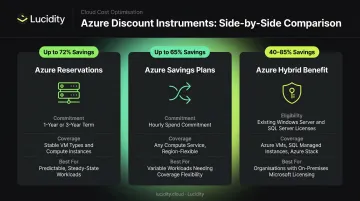
Azure offers three primary discount mechanisms:
- Azure Reservations — up to 72% savings versus pay-as-you-go for eligible VMs, with 1-year or 3-year commitment terms
- Azure Savings Plans — up to 65% savings on select compute services, with more flexibility than Reservations
- Azure Hybrid Benefit — up to 40% savings for Windows Server, 55% for SQL Server, and up to 85% when combined with Reservations
These instruments require accurate usage forecasting to apply correctly. In multi-cloud environments where workloads shift across providers, commitment decisions are often made with incomplete data — leaving savings unrealized or generating locked-in spend on underused capacity.
Storage Waste from Unmanaged Azure Managed Disks
Over-provisioned managed disks, unattached volumes left behind after VM deletions, and disks with zero I/O activity generate continuous charges that seldom appear in standard cost reviews. The FinOps Foundation's working group on Azure Managed Disks identifies free disk space analysis as a key practice for surfacing this waste — precisely because native tooling doesn't surface it automatically.
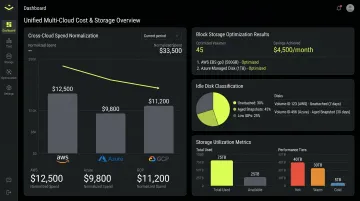
Lucidity's platform identifies four distinct categories of idle disks: unattached, reserved, unmounted, and zero-I/O. Together, these four types can represent up to 70% of unused block storage spend — a number that native dashboards won't surface without this level of classification.
Cross-Cloud Egress and Data Transfer Costs
When Azure workloads communicate with services on AWS or GCP (through APIs, data pipelines, or shared infrastructure), egress fees accumulate on both sides. Azure's bandwidth pricing charges outbound data transfer at tiered rates: the first 100 GB/month is free, the next 10 TB runs at $0.087/GB, with rates declining at higher volumes.
Inbound transfer is free, which creates a cost asymmetry that's easy to underestimate in architectures built for cross-cloud data movement.
Neither cloud's native tooling surfaces these costs in a unified way, so they're frequently misclassified or missed entirely in standard cost allocation workflows.
Cost-Reduction Strategies for Azure Multi-Cloud Cost Management
Where costs come from determines which strategy will actually move the number. The three categories below address decisions made before provisioning, governance while resources run, and the organizational conditions that either enable or prevent accountability.
Strategies That Reduce Costs by Changing Decisions
These are choices made before or at the time resources are provisioned — the decisions that lock in either savings or waste before a single billing cycle runs.
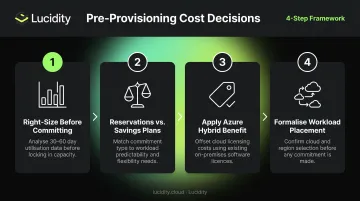
Right-size before committing. Validate utilization data over a 30–60 day lookback period before selecting a Reservation or Savings Plan. Azure's recommendation engine evaluates usage over 7, 30, and 60-day windows. Committing to the wrong SKU converts a discount into stranded spend — Reservations are use-it-or-lose-it when no matching resources run in a billing hour.
Reservations vs. Savings Plans: match to workload stability. Use Reservations for fixed, predictable instance types. Use Savings Plans where the VM family or region may evolve. Applying Savings Plans uniformly without this distinction reduces the effective savings rate.
Apply Azure Hybrid Benefit deliberately. Organizations running Windows Server or SQL Server on Azure can apply existing on-premises licenses to reduce VM costs. This is overlooked during multi-cloud migrations, when teams are focused on architecture decisions rather than licensing optimization.
Formalize workload placement decisions. Not every workload belongs on Azure. Identify which services benefit from Azure-native integrations (Microsoft 365, Active Directory, Azure AI) versus workloads that run more cost-efficiently on another provider. Document that logic as a reusable placement framework rather than deciding it ad hoc each time.
Strategies That Reduce Costs Through Operational Governance
These are operational improvements that reduce cost while Azure resources are actively running. Not architecture changes — governance discipline that catches waste before it compounds.
Enforce consistent tagging across all cloud providers. Without a common schema covering environment, team, workload, and cost center across Azure, AWS, and GCP, cost allocation is fragmented and waste is invisible. Enforce standards through Azure Policy or equivalent tools on each provider.
Replace native-only monitoring with unified cost visibility. Azure Cost Management provides strong insights within Azure's billing scopes, but cannot normalize spend across AWS or GCP. Third-party platforms that unify billing data — especially those adopting the FinOps FOCUS standard — are necessary for cross-cloud anomaly detection and forecasting.
Automate block storage optimization. Managed disk over-provisioning and idle volumes are consistently underaddressed in Azure environments — and rarely surfaced by native tools. Lucidity's AutoScaler right-sizes block storage in real time with zero downtime; its Lumen product classifies every idle disk by type (unattached, reserved, unmounted, zero-I/O) so teams can act on waste safely. Across assessments covering over 100 PB of data, average disk utilization starts at 30%. Lucidity's platform brings it to 75%.
Configure automated budget alerts and anomaly detection across all clouds. Static monthly budgets are insufficient when spend can shift quickly across providers. Real-time alerts tied to both Azure-level and aggregate multi-cloud thresholds let teams act before a billing cycle closes.
Strategies That Reduce Costs by Changing the Organizational Context
These address structural conditions that either enable or prevent cost accountability from taking hold across cloud boundaries.
Establish a cross-functional FinOps team with multi-cloud scope. The FinOps framework defines FinOps as a collaborative practice between engineering, finance, and operations. When no single function owns cross-cloud accountability, waste accumulates in the gaps between team boundaries. A FinOps function covering Azure commitments and the full provider mix creates the shared ownership needed for sustained optimization.
Adopt FinOps FOCUS for billing data normalization. The FinOps Open Cost and Usage Specification (FOCUS) provides a common schema for billing data from AWS, Azure, GCP, and other providers. Azure, AWS, Google, and Oracle have all adopted FOCUS 1.0. Organizations that implement it can analyze multi-cloud cost in a unified model — rather than reconciling three separate billing formats manually — which is a prerequisite for accurate forecasting and chargeback.
Centralize commitment management across providers. Azure Reservations, AWS Savings Plans, and GCP Committed Use Discounts are typically managed in separate workflows by separate teams. Consolidating commitment planning into a single strategy, supported by unified utilization data, prevents over-commitment on one cloud and under-optimization on another.
Conclusion
Multi-cloud cost reduction for Azure starts with knowing where costs actually originate — in provisioning decisions made before resources go live, in governance gaps while they run, or in structural conditions that prevent accountability from forming across cloud boundaries.
Organizations that pair FinOps practices with automated governance, cross-cloud visibility, and autonomous storage optimization — the kind that runs without human intervention — convert that understanding into measurable savings. The goal isn't just a lower bill. It's a cloud environment where every dollar maps to a deliberate decision.
Frequently Asked Questions
What is the biggest hidden cost in Azure multi-cloud environments?
Azure managed disk waste — over-provisioned volumes, unattached disks left after VM deletions, and zero-I/O resources — is one of the most consistently overlooked cost drivers. Native Azure tools don't classify or surface these idle categories clearly, and multi-cloud visibility gaps allow charges to compound across billing cycles before anyone reviews them.
How does Azure Cost Management differ from third-party multi-cloud cost tools?
Azure Cost Management provides strong native visibility within Azure's billing and resource scopes but cannot normalize or compare spend across AWS or GCP. Third-party platforms unify billing data across all providers into a single view, enabling cross-cloud cost allocation, anomaly detection, and forecasting that native tools cannot deliver alone.
What is the FinOps framework and how does it apply to Azure multi-cloud cost management?
FinOps is a cross-functional practice that aligns engineering, finance, and operations around shared cloud cost accountability. In a multi-cloud context, it structures cost allocation to specific teams, manages commitments across providers, and drives continuous optimization rather than one-time fixes.
How do Azure Reservations and Savings Plans differ, and which should I use in a multi-cloud strategy?
Reservations offer deeper discounts for stable, specific VM types; Savings Plans provide more flexibility across compute services. In multi-cloud environments, Savings Plans suit variable or shifting workloads, while Reservations work best for predictable, long-running instances where the type is unlikely to change.
What is the first step to implementing multi-cloud cost management for Azure?
The first step is establishing unified visibility — ensuring Azure billing data can be viewed alongside AWS and GCP spend in a normalized format, and that resources are tagged consistently across all providers so costs can be attributed to the teams and workloads generating them.
How can organizations reduce Azure storage costs in a multi-cloud environment?
Start by auditing Azure managed disks for idle, unattached, and over-provisioned volumes — Lucidity's free Assessment tool surfaces this in under five minutes, with no agents or infrastructure changes needed. Then implement automated policies or autonomous optimization tools to right-size storage continuously, cutting one of the most persistent sources of Azure waste.