The waste compounds quietly: idle compute instances, over-provisioned storage volumes, untagged resources accumulating charges month after month. And 85% of organizations identify managing cloud spend as a top challenge — meaning this isn't unique to teams just starting out.
Cloud cost management tools exist to close that gap. But with native utilities, multi-cloud FinOps platforms, and specialized optimizers all competing for budget and attention, knowing which tool fits your environment matters more than picking the most popular one.
This guide covers the best cloud cost management tools for AWS and Azure — from free native utilities to enterprise-grade platforms — evaluated for visibility depth, optimization capability, and real-world impact.
Key Takeaways
- Cloud cost management tools provide visibility into spend, detect waste, and drive optimization across AWS and Azure environments.
- Native tools (AWS Cost Explorer, Azure Cost Management) are free starting points but limited in automation and multi-cloud coverage.
- Third-party platforms like Vantage and CloudHealth add multi-cloud reporting, forecasting, and governance.
- Specialized tools address specific cost categories — like block storage waste — that broad platforms routinely miss.
- The best fit depends on your cloud mix, team structure, and which cost categories are driving the most overspend.
What Is Cloud Cost Management (and Why It Matters for AWS & Azure Users)
Cloud cost management is the continuous practice of gaining visibility into cloud spend, identifying waste, enforcing governance, and optimizing resource allocation across compute, storage, networking, and related services.
For AWS and Azure users, the challenge is structural. Both platforms price services granularly, with hundreds of SKUs, pricing dimensions, and discount programs. Without active management, costs drift upward through over-provisioned volumes, orphaned resources, and missed reservation opportunities.
The business case for getting this right is growing. The FinOps Foundation's 2026 State of FinOps survey — covering $83B+ in annual cloud spend — found that **63% of organizations have now established FinOps teams**, with 78% reporting into the CTO or CIO organization. Cloud cost management has moved from a finance concern to an engineering and operations priority.
The tools below cover three tiers: native utilities for baseline visibility, multi-cloud platforms for managing complexity, and specialized layers for cost categories that general tools leave unaddressed.
Best Cloud Cost Management Tools for AWS & Azure
These tools were selected to reflect the range of environments and maturity levels enterprises actually operate in — from AWS-only teams getting started to multi-cloud organizations running dedicated FinOps programs. We evaluated each for visibility depth, optimization capability, multi-cloud support, and business impact.
AWS Cost Explorer
AWS Cost Explorer is Amazon's built-in cost analysis tool, available at no additional charge to all AWS account holders. It provides spend breakdowns by service, region, linked account, and tag — making it the natural starting point for any AWS cost management program.
Key differentiators:
- Pre-built dashboards for historical spend and up to 18-month forecasting
- Native Reserved Instance and Savings Plan recommendations based on actual usage patterns
- Integration with AWS Budgets for threshold-based alerts
- AWS Cost Anomaly Detection included for unusual spend identification
| Attribute | Details |
|---|---|
| Key Features | Cost breakdowns by service, account, and region; RI and Savings Plan recommendations; forecasting up to 18 months; anomaly detection |
| Best For | AWS-only organizations needing baseline visibility without tool budget; teams starting their FinOps practice |
| Pricing | Free for standard console use; API access charged at $0.01 per paginated request; hourly granularity available at approximately $0.01 per 1,000 usage records monthly |
The limitation is scope. Cost Explorer doesn't extend to Azure or other providers, and its optimization recommendations stay at the compute and commitment layer — it won't surface storage waste or Kubernetes cost inefficiencies.
Azure Cost Management + Billing
Azure Cost Management + Billing is Microsoft's native suite for tracking, allocating, and governing Azure spend. It's integrated directly with the Azure portal, Azure Advisor, and Azure Policy — giving Azure-focused teams a unified management experience without additional tooling.
Key differentiators:
- Budget creation with automated threshold alerts
- Cost analysis by resource group, subscription, or tag
- Recurring exports to Azure Storage for Power BI custom dashboards
- Azure Advisor integration for rightsizing and VM shutdown recommendations
| Attribute | Details |
|---|---|
| Key Features | Cost analysis by resource group, tag, and subscription; budget alerts; Azure Advisor rightsizing recommendations; scheduled data exports to Azure Storage |
| Best For | Azure-focused teams seeking free, integrated cost tracking and basic governance |
| Pricing | Free for Azure customers |
One important note: Microsoft retired the Connector for AWS in Azure Cost Management effective March 31, 2025. Cross-cloud visibility through Azure's native tools is no longer available — teams with AWS and Azure footprints will need a third-party platform for unified reporting.
Vantage
Vantage is a modern, developer-friendly FinOps platform supporting AWS, Azure, GCP, Kubernetes, and 20+ SaaS providers. It's built for engineering and finance teams that need unified cost visibility without significant operational overhead to deploy or maintain.
Key differentiators:
- Clean multi-cloud cost reports with virtual tagging for custom cost allocation
- Automated waste detection covering idle resources and rightsizing recommendations
- Autopilot for hands-off AWS Savings Plan optimization
- MCP (Model Context Protocol) integration launched April 2025, enabling AI-assisted cost analysis through LLM clients like ChatGPT and Claude
| Attribute | Details |
|---|---|
| Key Features | Multi-cloud cost reporting across AWS, Azure, GCP; virtual tagging; automated waste detection; RI/Savings Plan management; Kubernetes cost visibility; Terraform provider support |
| Best For | Mid-market and growth-stage companies managing multiple cloud providers who need more depth than native tools provide |
| Pricing | Free tier up to $2,500 tracked monthly spend (3 users, 6 months data retention); Pro from $30/month; Business from $200/month; Enterprise is custom |
Vantage is a practical step up from native tools for teams managing two or more cloud providers. The MCP integration is worth noting for engineering teams: it allows natural-language cost queries directly inside AI coding tools, which reduces context-switching during infrastructure work.
CloudHealth by Broadcom
CloudHealth (now CloudHealth by Broadcom following Broadcom's acquisition of VMware in November 2023) is a mature enterprise FinOps platform offering comprehensive multi-cloud cost management, governance, and policy-based automation. It's built for large organizations with complex environments and dedicated FinOps teams.
Key differentiators:
- Cross-subscription and cross-cloud cost allocation with chargeback and showback reporting
- ML-driven forecasting with extended budget horizons
- Policy-based automation for flagging and remediating governance violations
- Broad coverage across AWS, Azure, GCP, Oracle Cloud, Alibaba, and data center
| Attribute | Details |
|---|---|
| Key Features | Multi-cloud cost allocation and chargeback; policy-based governance automation; ML forecasting; Reserved Instance and Savings Plan management; security and compliance monitoring |
| Best For | Large enterprises ($500K+ annual cloud spend) with dedicated FinOps teams, complex organizational hierarchies, and cross-provider governance needs |
| Pricing | Annual subscription with custom enterprise pricing; contact Broadcom for current rates |
CloudHealth's depth is its differentiator — and also its complexity. It's a fit for enterprises that have outgrown lighter-weight platforms and need chargeback reporting across multiple business units.
Lucidity
Lucidity is an autonomous multi-cloud block storage management platform built specifically to address over-provisioned and idle block storage volumes on AWS (EBS) and Azure Managed Disks — a category of waste that general FinOps platforms consistently miss. It's featured in Forrester's Cloud Cost Optimization and Management Landscape Q3 2025 and named a 2025 Gartner Cool Vendor in Data Protection and Storage.
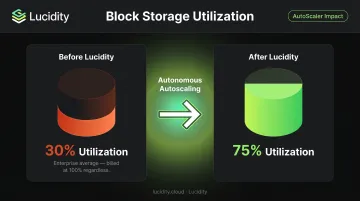
The core insight behind Lucidity is that broad FinOps platforms optimize at the compute and commitment layer — but block storage waste accumulates underneath, invisible to general-purpose dashboards. The average enterprise runs at 30% disk utilization. Lucidity raises that to 75% through autonomous, real-time autoscaling.
Key differentiators:
- Autonomous storage autoscaling that expands and shrinks volumes in real time with zero downtime
- AI-powered idle disk detection across four categories: unattached, reserved, unmounted, and zero-I/O
- Real-time visibility into every storage volume across AWS and Azure
- NoOps deployment — no code changes, no infrastructure modifications, no agents required
- Proven customer results: Dometic cut cloud storage spend by 52%; Iron Mountain eliminated hundreds of manual provisioning hours
| Attribute | Details |
|---|---|
| Key Features | Autonomous block storage autoscaling (expand/shrink with zero downtime); AI-powered idle disk detection across four categories; real-time multi-cloud storage visibility; NoOps deployment; SOC 2 compliant and FinOps certified |
| Best For | Enterprises on AWS and/or Azure with significant block storage footprints seeking automated, hands-free storage cost reduction |
| Pricing | Contact Lucidity for pricing; the platform delivers up to 70% savings on block storage spend. A free Assessment is available — no install, no commitment, results in ~5 minutes |
Every other tool on this list addresses compute costs, reservation coverage, or multi-cloud reporting. Lucidity operates in the layer beneath those — block storage — where over-provisioned volumes sit at 30% utilization and keep billing at 100%. It's a distinct problem that requires a distinct solution.
How We Chose the Best Cloud Cost Management Tools
The tools above were selected to reflect the actual range of FinOps maturity levels and cloud environments enterprises operate in — from teams establishing baseline visibility to organizations running multi-cloud cost programs at scale.
Evaluation criteria applied:
- Cloud provider coverage — AWS, Azure, and multi-cloud support
- Visibility depth — granularity of cost reporting and anomaly detection
- Optimization capability — automation, rightsizing, and waste detection
- Deployment ease — time to value and integration complexity
- Enterprise readiness — security compliance, certifications, and support
- Documented business impact — real customer outcomes, not just feature claims
These criteria also surface a common mistake: defaulting to native tools for everything, even as environments grow more complex. Native tools cover the basics well, but they fall short on multi-cloud reporting, deep storage analytics, and automated governance at scale.
The FinOps Foundation notes that organizations use 4.1 tools on average in their FinOps practice, typically combining native tooling, third-party platforms, and specialized layers. Storage and Kubernetes optimization tend to hold the largest untapped savings — which is why high-performing teams pair a general-purpose platform for compute visibility with a purpose-built solution for those categories.
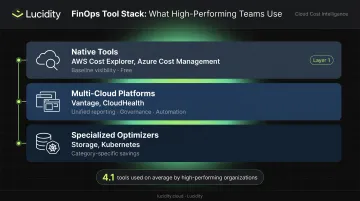
No single tool covers every cost category — the right stack starts with identifying where your overspend is actually concentrated.
Conclusion
The right cloud cost management tool depends on where you are in your FinOps journey. Native tools handle the basics at no cost. Multi-cloud platforms like Vantage and CloudHealth scale with organizational complexity. And specialized solutions like Lucidity address the cost categories that broad tools leave unoptimized.
Before investing in a new platform, audit your current toolset against your actual spend categories. If you're unsure where to begin, block storage is a reliable starting point — over-provisioning is widespread, the waste is quantifiable, and fixing it doesn't require infrastructure changes.
For enterprises on AWS or Azure looking to cut block storage costs without touching a line of code, Lucidity autonomously expands, shrinks, and optimizes storage — reducing costs by up to 70%. Start with a free Assessment to see exactly how much your environment is wasting. No install, no commitment, and results in about five minutes.
Frequently Asked Questions
What are the best cloud cost management tools for AWS and Azure?
The best tools fall into three categories: native utilities (AWS Cost Explorer, Azure Cost Management + Billing) for free baseline visibility, multi-cloud FinOps platforms (Vantage, CloudHealth by Broadcom) for unified reporting and governance, and specialized optimizers like Lucidity for block storage waste. The right choice depends on your environment's complexity and which cost categories are driving overspend.
What is the best AWS cost management tool?
AWS Cost Explorer is the free native baseline, covering spend breakdowns, forecasting, and Reserved Instance recommendations for AWS-only teams. For multi-cloud environments or teams needing automated waste detection, third-party platforms like Vantage or CloudHealth add significant capability beyond native tooling.
Which Azure service provides tools for cost analysis and budget management?
Azure Cost Management + Billing is Microsoft's native solution, covering cost analysis by resource group and subscription, budget alerts, and Azure Advisor rightsizing recommendations. It works best for Azure-centric teams. Note that the AWS connector was retired in March 2025, so cross-cloud visibility requires a third-party FinOps platform.
What is the difference between native cloud cost tools and third-party FinOps platforms?
Native tools (AWS Cost Explorer, Azure Cost Management) are free, single-cloud, and provide baseline visibility. Third-party platforms add unified multi-cloud reporting, deeper automation, anomaly detection, chargeback reporting, and governance features designed for complex, large-scale environments where native tools fall short.
How can I reduce cloud storage costs on AWS or Azure?
Common storage waste drivers include over-provisioned volumes, unattached disks, and idle snapshots that accumulate without cleanup. Lucidity autonomously identifies and right-sizes block storage volumes across four idle disk categories, reducing storage spend by up to 70% without downtime or manual engineering effort.
What features should I look for in a cloud cost management tool?
Prioritize tools that offer multi-cloud coverage, real-time visibility and anomaly detection, budget alerting, rightsizing automation, and governance with tagging enforcement. Also consider whether the tool addresses your specific cost categories — compute, storage, and Kubernetes each require different optimization approaches.