Introduction
95% of Fortune 500 companies run workloads on Azure, and Microsoft's cloud revenue hit $168.9 billion in FY2025 — a 23% year-over-year jump. That scale creates a proportional cost management problem.
Azure's pay-per-use model bills by the second across 200+ services, with pricing that varies by region, tier, and commitment type. Most teams struggle with the same patterns: overprovisioned VMs, managed disks attached to nothing, and Reserved Instances that never get right-sized. Each gap adds to a bill that grows faster than anyone tracks.
That behavior adds up fast. According to Flexera's 2026 State of the Cloud report, IaaS/PaaS wasted cloud spend has risen to 29% across organizations — nearly $1 in every $3 spent on cloud infrastructure producing no business value.
This post covers 20 Azure cost management tools organized by category — native Azure options, enterprise FinOps platforms, Kubernetes cost tools, and specialized infrastructure optimizers — along with a practical guide for choosing the right fit.
Key Takeaways
- Native tools (Microsoft Cost Management, Azure Advisor) are free baselines but can't allocate costs to business units without heavy tagging work
- Third-party FinOps platforms add multi-cloud support, unit economics, and automation native tools lack
- Kubernetes costs on AKS need dedicated tooling; general FinOps platforms miss namespace-level granularity
- Storage over-provisioning is the most overlooked Azure cost driver; average enterprise disk utilization sits at just 30%
- The best stack layers native tools + a FinOps platform + a specialized optimizer for your highest-cost gap
Why Azure Cost Management Is Challenging
Azure pricing spans hundreds of service types, multiple regions, tiered storage classes, Spot VMs, Reserved Instances, and Savings Plans. No single dashboard connects all of it to actual business value by default.
The three most common cost leaks:
- Over-provisioned VMs and managed disks — teams provision for peak demand and never revisit
- Idle or unattached resources — disks, IPs, and snapshots that accumulate without cleanup
- Misaligned commitment coverage — Reserved Instances bought without analyzing actual usage patterns
Three terms frequently get conflated, but each points to a different problem:
| Term | What It Means |
|---|---|
| Azure Cost Management | Monitoring spend, setting budgets, governance |
| Azure Cost Optimization | Actively reducing spend through right-sizing, commitments, cleanup |
| Azure Cost Analysis | Investigating why a specific bill line item spiked |
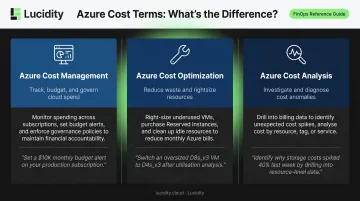
The tools in this list serve one or more of these functions. Pinning down which function you need — visibility, active reduction, or investigation — narrows a list of 20 tools down to 3 or 4 that actually fit.
Top 20 Azure Cost Management Tools for Cloud Savings
These tools are grouped by primary use case to help you identify what matches your situation fastest.
Native Azure Tools
1. Microsoft Cost Management + Billing
Built into the Azure portal at no extra cost. It monitors spending, sets budget alerts, detects anomalies, and exports cost data to Azure Storage. Power BI integration enables custom dashboards for stakeholders.
| Attribute | Details |
|---|---|
| Key Features | Cost Analysis, Budget Alerts, Anomaly Detection, Scheduled Exports, Cost Allocation Rules, Tag Inheritance |
| Best For | Azure-first organizations needing a zero-cost baseline |
| Pricing | Free for Azure |
Note: Microsoft ended support for the AWS Cost Management Connector on March 31, 2025. Cross-cloud monitoring now requires a third-party tool.
2. Azure Advisor
A native recommendation engine that analyzes resource configurations and usage patterns to surface personalized cost, performance, and security recommendations with no setup required.
| Attribute | Details |
|---|---|
| Key Features | Rightsizing recommendations, RI purchasing guidance, idle resource detection |
| Best For | Teams new to Azure cost optimization seeking quick wins |
| Pricing | Free |
Advisor is often the fastest path to initial savings. It flags specific underutilized VMs tied to your subscription with no configuration overhead.
3. Azure Pricing Calculator
A pre-purchase estimation tool for modeling Azure service costs before provisioning. Supports authenticated enterprise pricing for EA customers.
| Attribute | Details |
|---|---|
| Key Features | Service configuration modeling, region pricing comparison, Excel export |
| Best For | Architecture teams estimating costs before deployment |
| Pricing | Free |
Enterprise FinOps Platforms
4. CloudZero
CloudZero ingests cost data from Azure, AWS, GCP, Kubernetes, Snowflake, and third-party tools, then allocates 100% of spend to business dimensions — cost per customer, feature, or team — without requiring a complete tagging strategy.
| Attribute | Details |
|---|---|
| Key Features | Business-dimension cost allocation, AnyCost™ API, AKS cost tracking, anomaly detection |
| Best For | Engineering and finance teams needing granular unit economics across multi-cloud |
| Pricing | Custom; contact for pricing |
5. Finout
An enterprise FinOps platform with a "MegaBill" that consolidates spend across Azure, AWS, GCP, Kubernetes, Snowflake, Databricks, and AI providers into one dashboard. Virtual tags auto-classify untagged resources without modifying existing resource tags.
| Attribute | Details |
|---|---|
| Key Features | Virtual tags, MegaBill consolidation, anomaly detection, AI cost visibility |
| Best For | SaaS companies with multi-cloud environments needing unit economics without retagging |
| Pricing | Flat monthly rate; verify current pricing with vendor |
6. IBM Cloudability
Originally Apptio, now IBM — Cloudability tracks and allocates costs across Azure, AWS, and GCP with rightsizing recommendations and Reserved Instance guidance. Particularly well-suited for showback and chargeback reporting by department or initiative.
| Attribute | Details |
|---|---|
| Key Features | Cost allocation by team/department, RI recommendations, forecasting |
| Best For | Large enterprises with dedicated IT finance teams |
| Pricing | Subscription-based; custom pricing; verify with vendor |
7. VMware Tanzu CloudHealth (Broadcom)
Following Broadcom's acquisition of VMware in November 2023, CloudHealth provides Azure financial management, security, and compliance monitoring in one platform, with automated policy enforcement.
| Attribute | Details |
|---|---|
| Key Features | Custom policies, cost anomaly alerts, rightsizing, compliance monitoring |
| Best For | Large enterprises managing cost and compliance across multiple cloud providers |
| Pricing | Subscription-based; custom quote required |
8. Harness Cloud Cost Management
Part of the Harness software delivery platform, it integrates cost visibility directly into CI/CD pipelines. Auto-stopping pauses non-production workloads automatically during idle periods, reducing Azure spend during off-hours.
| Attribute | Details |
|---|---|
| Key Features | Auto-stopping, rightsizing, budgets, forecasting, what-if analysis |
| Best For | DevOps teams wanting cost management embedded in software delivery pipelines |
| Pricing | Custom; free tier available |
9. Flexera One
A hybrid cloud management platform for cost optimization, governance, and software asset management. Following its acquisition of the Spot by NetApp portfolio in March 2025, Flexera now includes spot instance automation for Azure workloads.
| Attribute | Details |
|---|---|
| Key Features | Hybrid cost visibility, spot instance automation, RI management, compliance |
| Best For | Large enterprises with complex hybrid and multi-cloud environments |
| Pricing | Custom; verify with vendor |
10. Turbo360
An Azure-native cost management platform focused exclusively on the Azure ecosystem. Offers anomaly detection, cost allocation across multiple tenants, and deep integration with fewer configuration requirements than general multi-cloud tools.
| Attribute | Details |
|---|---|
| Key Features | Anomaly detection, multi-tenant cost allocation, rightsizing, Azure-native dashboard |
| Best For | Azure-centric organizations managing multiple tenants or subscriptions |
| Pricing | Custom; verify with vendor |
11. Ternary
A FinOps platform for Azure focused on unused resource identification, rightsizing, and commitment management including Azure Reservations and Savings Plans. The Jira integration lets engineering teams act on cost recommendations through existing ticketing workflows.
| Attribute | Details |
|---|---|
| Key Features | Rightsizing, Reservations/Savings Plans management, Jira integration |
| Best For | Engineering-led organizations wanting cost work tied to sprint workflows |
| Pricing | Custom; verify with vendor |
Kubernetes and Container Cost Tools
12. CAST AI
An AI-powered optimization platform for Kubernetes environments on AKS, EKS, GKE, and KOPS. Goes beyond visibility to autonomous remediation — continuously rebalances nodes and shifts eligible workloads to spot instances without manual intervention.
| Attribute | Details |
|---|---|
| Key Features | AKS autoscaling, spot instance automation, cluster rebalancing, cost per namespace/workload |
| Best For | Organizations running significant AKS workloads seeking automated cost reduction |
| Pricing | Pay-as-you-go; free tier for basic monitoring |
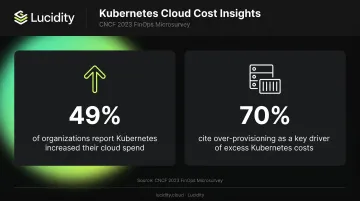
CNCF's 2023 FinOps microsurvey found Kubernetes increased cloud spend for 49% of organizations, with over-provisioning cited by 70% as a key driver — making AKS-specific tooling worth evaluating separately.
13. IBM Kubecost
An open-source-based Kubernetes cost monitoring platform (acquired by IBM in September 2024) that tracks AKS costs by deployment, namespace, cluster, label, and service.
| Attribute | Details |
|---|---|
| Key Features | Cost by namespace/deployment/cluster, multi-cluster unified view, rightsizing alerts |
| Best For | Engineering teams needing detailed Kubernetes cost attribution across AKS clusters |
| Pricing | Free tier available; paid plans based on cluster usage |
14. Kubex (formerly Densify)
Rebranded in January 2026 to reflect its focus on end-to-end Kubernetes resource optimization. Kubex automatically sets container resource requests and limits across AKS, EKS, GKE, and OpenShift — with added support for GPU and AI workloads where overprovisioning is especially costly.
| Attribute | Details |
|---|---|
| Key Features | Automated resource requests/limits, GPU/AI workload support, multi-cluster optimization |
| Best For | Teams running GPU, AI, or complex containerized workloads on AKS |
| Pricing | Custom; verify with vendor |
Specialized Optimization Tools
15. Lucidity
Lucidity is an autonomous cloud block storage management platform providing real-time visibility and zero-downtime optimization of Azure Managed Disks. Its AutoScaler autonomously expands, shrinks, and rightsizes disk volumes without code changes or infrastructure modifications. Recognized as a 2025 Gartner Cool Vendor in Data Protection and Storage.
Unlike most FinOps platforms, Lucidity addresses storage over-provisioning directly. Lucidity's Lumen product identifies all four types of idle disks — unattached, reserved, unmounted, and zero-I/O — that standard Azure dashboards miss.
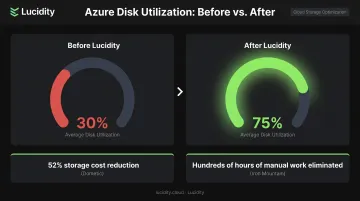
Across 600+ enterprise assessments covering 100+ petabytes, average disk utilization before Lucidity sits at 30%. After deployment, it rises to 75%.
Customers like Dometic have reduced cloud storage spend by 52%, while enterprises like Iron Mountain have eliminated hundreds of hours of manual provisioning work.
| Attribute | Details |
|---|---|
| Key Features | Autonomous disk autoscaling, real-time storage visibility, idle disk detection (4 types), zero-code integration, SOC 2 compliant, FinOps certified |
| Best For | ITOps, DevOps, and FinOps teams at enterprises running significant Azure Managed Disk workloads |
| Pricing | Custom; contact Lucidity for enterprise pricing |
16. ProsperOps
A fully automated commitment management platform that optimizes Azure Savings Plans and Reserved Instances using Autonomous Discount Management (ADM). Closes the execution gap in Azure's native commitment tools — Azure recommends savings plans but doesn't rebalance them automatically.
| Attribute | Details |
|---|---|
| Key Features | Autonomous Discount Management, Savings Plans and RI optimization, Intelligent Showback |
| Best For | FinOps teams with significant Azure compute commitments wanting hands-free discount optimization |
| Pricing | Performance-based; percentage of savings delivered |
17. IBM Turbonomic
An AI-driven application resource management platform (acquired by IBM in 2021) that continuously assures Azure application performance while minimizing resource waste. Unlike reactive cost tools, it takes a proactive application-centric approach , continuously right-sizing resources to match real application demand.
| Attribute | Details |
|---|---|
| Key Features | AI-driven resource management, real-time rightsizing automation, application performance assurance |
| Best For | Enterprises needing continuous, automated resource optimization tied to application performance |
| Pricing | Custom; free trial available |
18. Yotascale
Focuses on engineering accountability for Azure spend — breaking down costs by team, application, and Kubernetes namespace with automated allocation tied to engineering workflows. Makes cost data actionable at the team level rather than just finance-level reporting.
| Attribute | Details |
|---|---|
| Key Features | Cost by team/app/namespace, automated allocation, anomaly detection, forecasting |
| Best For | Organizations building an engineering-owned FinOps culture |
| Pricing | Custom; verify with vendor |
19. BMC Helix Cloud Cost
A unified cost management platform covering private cloud, public cloud (including Azure), and on-premises environments in a single interface, with predictive analytics to anticipate overruns before they occur.
| Attribute | Details |
|---|---|
| Key Features | Predictive analytics, anomaly alerts, idle resource detection, hybrid cloud coverage |
| Best For | Enterprises managing hybrid IT with significant on-premises infrastructure alongside Azure |
| Pricing | Custom; verify with vendor |
20. Kion
A cloud governance and cost management platform that controls Azure costs through budget enforcement, policy guardrails, and real-time usage tracking. The governance-first approach means it not only flags overspending but enforces policies that prevent it.
| Attribute | Details |
|---|---|
| Key Features | Budget enforcement, policy guardrails, real-time visibility, multi-cloud support |
| Best For | Organizations prioritizing governance and compliance-driven cost control |
| Pricing | Custom; verify with vendor |
How to Choose the Right Azure Cost Management Tool
Start with a diagnosis, not a feature list. Your biggest cost pain point determines which category of tool to evaluate first:
- Visibility and budget governance → Start with native Azure tools or a FinOps platform
- Kubernetes cost attribution → Evaluate AKS-specific tools like CAST AI or Kubecost
- Commitment management → ProsperOps automates what Azure Advisor only recommends
- Storage waste → General FinOps tools don't reach block storage; Lucidity does
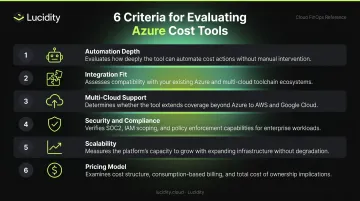
Six Criteria to Evaluate Any Shortlisted Tool
- Automation depth — does it alert you, or does it act? Alerting tools require human follow-through; autonomous tools close the loop
- Integration fit — works with your existing Azure tagging strategy, or forces you to rebuild it from scratch
- Multi-cloud support — relevant if you run workloads outside Azure
- Security and compliance — SOC 2 compliance and FinOps certification matter for enterprise procurement
- Scalability — can it grow with your environment without re-implementation?
- Pricing model — performance-based pricing aligns vendor incentives with your savings; flat fees add to the cost problem
The Most Common Selection Mistake
Choosing the tool with the most features rather than the best fit. A platform that requires weeks of tagging work before it delivers any value delays ROI for months — often long enough for internal momentum to die.
The same logic applies to vendor focus. A tool built for AWS-first environments will underserve a predominantly Azure footprint, no matter how polished the dashboard looks. Start with your top cost driver, find a tool purpose-built for it, then expand from there.
Conclusion
No single tool covers every Azure cost challenge. The most effective organizations layer:
- Native baseline: Microsoft Cost Management + Azure Advisor for visibility and governance
- FinOps platform: CloudZero, Finout, or a similar tool for multi-cloud allocation and unit economics
- Kubernetes layer: CAST AI or Kubecost if AKS workloads are significant
- Storage optimizer: A purpose-built tool like Lucidity for block storage waste that FinOps platforms miss
Cloud cost management doesn't end after your first audit. The tools that hold their value over time automate what would otherwise be manual work, scale without requiring re-configuration, and produce output that engineering and finance teams can both interpret and act on.
If Azure Managed Disk overprovisioning is eating into your budget, you're not alone — average disk utilization across enterprise environments sits around 30%. Lucidity's autonomous block storage optimization integrates without infrastructure changes and identifies exactly where that waste is concentrated. Start a free Assessment to see what your Azure storage environment is actually costing you.
Frequently Asked Questions
Is Azure Cost Management free?
Microsoft Cost Management is free for monitoring Azure spend within the Azure portal. The AWS Connector for cross-cloud monitoring was retired on March 31, 2025. Third-party tools on this list carry their own pricing structures.
What does Azure Cost Management do?
It monitors, allocates, and optimizes Azure spending through cost analysis, budget alerts, anomaly detection, scheduled data exports, and integration with Azure Advisor recommendations — all accessible directly within the Azure portal at no extra cost.
Which Azure services can be used to manage costs?
Core monitoring tools include Microsoft Cost Management + Billing, Azure Advisor, and the Azure Pricing Calculator. For cost reduction, Azure offers Reserved Instances, Savings Plans, Azure Hybrid Benefit, and Spot VMs as built-in mechanisms.
What is the difference between Azure Cost Management and Azure Advisor?
Azure Cost Management focuses on monitoring, reporting, and allocating spend. Azure Advisor analyzes your usage and configuration to generate specific recommendations for reducing cost, improving performance, and strengthening security. The two tools are complementary and integrate directly with each other.
How do I reduce Azure cloud storage costs?
Most Azure storage waste comes from over-provisioned managed disks, unattached volumes, and disks with zero I/O activity. Right-sizing, deleting idle disks, and using autonomous storage optimization tools can significantly cut this waste — without manual scripting or infrastructure changes.
What is the best third-party tool for Azure cost management?
It depends on your primary cost driver:
- Multi-cloud unit economics: CloudZero or Finout
- AKS Kubernetes costs: CAST AI
- Commitment management automation: ProsperOps
- Azure block storage waste: Lucidity (the only FinOps tool focused specifically on this layer)
Audit your top cost drivers first, then match the tool to that problem.