
Introduction
Azure's pay-as-you-go model is its greatest strength — and its most common trap. Without a structured approach, teams provision resources freely, storage volumes accumulate without owners, and finance teams receive monthly invoices with no context for action.
According to Flexera's 2026 State of the Cloud report, 29% of cloud spend is wasted, 85% of organizations name cost management their top priority, and cloud budgets are already running 17% over their limits.
Azure FinOps is the framework built to address this. It applies the FinOps Foundation's operational model to Microsoft Azure — bringing engineering, finance, and business teams into shared cost accountability before the next invoice arrives.
What follows is a practical breakdown of the six core FinOps principles, how they map to Azure environments, the three-phase lifecycle for operationalizing them, and the specific mistakes that derail even well-funded programs.
Key Takeaways
- Azure FinOps is a cultural and operational framework that requires cross-functional ownership of cloud spend — not a tool you deploy and walk away from
- The FinOps Foundation defines six core principles that guide Azure cost decisions, from team collaboration to taking advantage of the variable cost model
- Teams implement FinOps through a repeating three-phase cycle: Inform → Optimize → Operate
- Common failure points include siloing cost data in finance, treating FinOps as a one-time audit, and ignoring storage waste
- Without structure, Azure environments routinely accumulate over-provisioned VMs, untagged workloads, and unattached managed disks with no cost owner
What Is Azure FinOps?
Azure FinOps is the application of the FinOps Foundation's operational framework to Microsoft Azure environments. It enables engineering, finance, and business teams to make decisions that maximize business value from cloud spend — not simply reduce it.
Two clarifications worth keeping front of mind:
- Azure FinOps is not cost-cutting. The goal is value maximization. Sometimes that means spending more in the right places.
- Azure FinOps is not a Microsoft product. Azure Cost Management is a tool. FinOps is the discipline that governs how that tool gets used, by whom, and toward what outcomes.
Microsoft has aligned its tooling — Azure Advisor, Azure Cost Management, Azure Policy — with the FinOps Foundation framework. Microsoft's own documentation acknowledges its guidance is largely based on the FinOps Framework and adapted from customer and partner lessons, though the framework itself remains provider-agnostic.
Why Azure FinOps Principles Matter
Azure's cost management challenge is structural, not accidental.
What makes Azure uniquely difficult to govern:
- Hundreds of services with distinct pricing models
- Consumption-based billing that scales with demand spikes
- Multiple rate optimization constructs: Reserved Instances, Savings Plans, Spot VMs, Hybrid Benefit, negotiated discounts
- No native cross-team accountability structure — any engineer with permissions can provision resources
Without a FinOps practice in place, the same problems appear across Azure environments:
- VMs get provisioned for peak load and never right-sized
- Managed disks remain attached or orphaned after workload deletion
- Storage volumes grow without lifecycle policies
- Finance teams receive monthly bills they cannot interpret or act on
The result is waste at scale. Lucidity's analysis across 600+ storage assessments covering more than 100 petabytes of data found that enterprises average just 30% disk utilization. Most provisioned Azure storage sits largely idle.
Microsoft has acknowledged this directly, building Azure Advisor recommendations specifically to flag unattached disks, over-provisioned VMs, and snapshot inefficiencies. But Azure Advisor surfaces recommendations — it doesn't assign ownership, enforce budgets, or drive cross-team action. That's what a FinOps framework provides: defined roles, shared accountability, and governance processes that turn cost visibility into cost control.
The Six Core Azure FinOps Principles
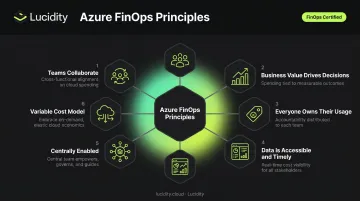
The FinOps Foundation defines six principles that form the philosophical backbone of any FinOps practice. These aren't sequential steps to complete in order. They're concurrent cultural behaviors that run in parallel across teams.
Principle 1: Teams Need to Collaborate
FinOps treats cost as a shared efficiency metric. Engineering, finance, IT, and product teams move from siloed reporting to joint accountability.
On Azure, this means:
- Establishing a FinOps Center of Excellence (or central function)
- Creating shared dashboards across teams
- Running regular cross-functional cost review cycles
- Using Azure Policy to enforce budget governance consistently
The State of FinOps 2026 data shows 78% of FinOps practices report to the CTO or CIO organization — a signal that cost management is increasingly treated as an engineering and operations discipline, not purely a finance function.
Principle 2: Business Value Drives Technology Decisions
Every Azure resource decision — VM size, storage tier, database configuration — should be evaluated against business outcomes, not technical preference alone.
This means defining unit economics: cost per transaction, cost per active user, cost per processed record. Azure Cost Management combined with Power BI reporting can connect infrastructure spend directly to revenue impact. This shifts cloud spend from fixed overhead into a measurable cost driver tied to business performance.
Principle 3: Everyone Takes Ownership for Their Usage
Responsibility for cloud spend must sit with the engineers and teams who provision resources — not be absorbed into a central cost center.
On Azure, distributed ownership is implemented through:
- Resource tagging strategies tied to team, environment, and workload
- Subscription-level cost allocation
- Chargeback or showback models
- Accountability metrics visible at the team level
The engineering action gap is real: 40% of FinOps practitioners identify getting engineers to take action as their top challenge. Unowned resources — particularly idle or unattached managed disks — accumulate silently and go unaddressed for months.
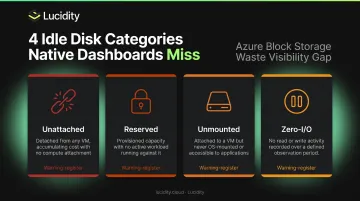
Tools like Lucidity's Lumen help close that gap by identifying four distinct idle disk categories (unattached, reserved, unmounted, and zero-I/O) that together can represent up to 70% of unused block storage spend. One-click cleanup requires no scripts or manual investigation.
Principle 4: FinOps Data Should Be Accessible, Timely, and Accurate
Real-time visibility is a prerequisite for action. This principle requires:
- Proper data ingestion and normalization
- Anomaly detection
- Reporting pipelines that surface cost data to the right personas at the right cadence
Azure Cost Management, Azure Monitor, and cost export integrations support this — but only if data is structured correctly before reporting begins. Untagged resources, improperly scoped subscriptions, and missing allocation rules produce dashboards that look complete but can't drive decisions.
Principle 5: FinOps Should Be Enabled Centrally
Distributed ownership does not mean decentralized governance. A central FinOps team owns:
- Rate negotiations: Reserved Instances (up to 72% savings vs. pay-as-you-go), Savings Plans (up to 65% on compute), Azure Hybrid Benefit
- Tagging and naming standards enforced via Azure Policy
- Commitment-based purchases managed across business units
- Training and tooling that enables decentralized teams to act responsibly
Without centralization, each team purchases commitments independently, economies of scale collapse, and discount opportunities go unused.
Principle 6: Take Advantage of the Variable Cost Model
The cloud's pay-as-you-go nature is an asset — if teams actively manage it. This means:
- Right-sizing VMs continuously, not at deployment
- Using Spot instances for fault-tolerant workloads
- Setting auto-shutdown policies for non-production environments
- Applying Azure Blob Storage lifecycle policies to move infrequently accessed data to cooler tiers
- Storing managed disk snapshots in Standard Storage instead of Premium Storage — a change Azure Advisor recommends — can cut snapshot costs by 60%
- Treating infrastructure sizing as an ongoing cycle, not a one-time planning decision
How the Azure FinOps Lifecycle Works
The FinOps Foundation's three-phase lifecycle — Inform, Optimize, Operate — runs continuously, not once. Different teams or workloads may be in different phases simultaneously. Maturity is measured capability by capability, not as a single organizational level.
Phase 1: Inform
The Inform phase establishes the visibility and accountability that optimization depends on.
Key activities:
- Audit current Azure resource allocation: what exists, who owns it, what it costs
- Establish tagging taxonomies: team, environment, workload, cost center
- Activate Azure Cost Management and billing exports
- Build dashboards by team or workload, not just aggregate invoices
- Set baseline benchmarks: utilization rates, spend by service, idle resource inventory
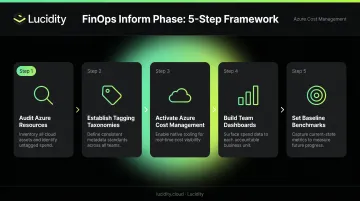
The goal: ensure every stakeholder knows what is being spent, by whom, and on what. Lucidity's Assessment tool complements this phase by surfacing storage-specific utilization data (average disk utilization, idle disk inventory, downtime risk) in approximately five minutes, without requiring agents or infrastructure changes.
Phase 2: Optimize
With visibility established, teams move to waste reduction and efficiency improvement.
Usage optimization:
- Right-size underutilized VMs using Azure Advisor (which evaluates CPU, memory, and network over configurable 7–90 day lookback periods)
- Identify and delete unattached managed disks
- Apply storage lifecycle policies
- Configure auto-scaling to match demand
Rate optimization:
- Purchase Reserved Instances for stable, predictable workloads
- Apply Savings Plans for flexible compute commitments
- Activate Azure Hybrid Benefit for eligible Windows Server and SQL workloads
Optimization has no finish line. Each cycle feeds new data into the next, which is where the Operate phase takes over.
Phase 3: Operate
The Operate phase embeds FinOps into how engineering teams ship and scale on Azure.
- Define KPIs: cost per unit, budget variance thresholds, utilization targets
- Set up anomaly alerts before costs accumulate
- Run regular FinOps review cadences (monthly at minimum)
- Adjust governance policies as workloads evolve
This phase ensures that optimization gains do not erode over time. New resources get provisioned under governance policies. Budget overruns trigger alerts rather than surprises on next month's invoice.
Common Mistakes Teams Make When Applying Azure FinOps Principles
Treating FinOps as a Finance-Only Function
The most widespread mistake is assigning cost management to a single team and calling it done. When cost visibility is siloed — even within a capable finance team — the engineers who actually provision resources never see the data and have no accountability for their decisions. The FinOps program produces reports, not outcomes.
State of FinOps data confirms that 78% of FinOps practices sit within the CTO or CIO organization, not finance. The discipline belongs closest to the teams with the power to change usage behavior.
Running FinOps as a One-Time Audit
Quarterly cost reviews discover waste retrospectively. By the time a report surfaces an anomaly, the billing cycle has already closed. The FinOps lifecycle is explicitly iterative — Inform, Optimize, and Operate repeat continuously. Organizations that treat FinOps as a periodic exercise build no real-time feedback loops and cannot course-correct within a billing period.
Ignoring Storage as a Cost Category
Most Azure FinOps programs concentrate on compute: VM right-sizing, reserved capacity, container optimization. Storage — particularly managed disks — rarely triggers performance alerts, so it stays off optimization dashboards.
Azure managed disks are billed on provisioned capacity, not actual usage. An unattached disk detached after a VM deletion keeps incurring charges until explicitly deleted. Disks provisioned at a higher tier than workloads require are charged at the premium-tier rate regardless of actual IOPS consumed.
Lucidity's Lumen specifically addresses this gap. Unlike Azure Advisor, which identifies only unattached disks, Lumen classifies idle storage across four categories that native dashboards miss entirely:
- Unattached: disks no longer associated with any VM
- Reserved: provisioned capacity sitting idle with no active workload
- Unmounted: disks attached to a VM but not mounted by the OS
- Zero-I/O: disks with no read/write activity over a defined period
Conclusion
Azure FinOps principles provide a structured, culturally grounded approach to maximizing cloud value. Understanding the six principles is the starting point — operational discipline through the Inform-Optimize-Operate lifecycle is what sustains results.
Implementation sequence matters. Organizations that start with visibility and tagging before attempting rate optimization or centralized governance build more durable practices than those attempting wholesale transformation at once. The sequence that holds up in practice:
- Establish visibility and tagging before touching rate optimization
- Optimize spend once your cost data is reliable and attributed
- Embed FinOps into team workflows so it operates continuously, not episodically
The principles are stable. What evolves is how deeply your organization applies them — and that depth is what separates teams that control cloud spend from those that just report it.
Frequently Asked Questions
What are the key principles of FinOps?
The FinOps Foundation defines six principles: teams collaborate, business value drives decisions, everyone owns their usage, data is accessible and timely, FinOps is centrally enabled, and organizations take advantage of the variable cost model. All six apply equally to Azure environments.
What is Azure FinOps?
Azure FinOps is the application of the FinOps operational framework to Microsoft Azure, enabling engineering, finance, and business teams to manage and optimize cloud spend collaboratively. The goal is maximizing business value — not simply reducing costs.
How does Azure FinOps differ from general FinOps?
Azure FinOps applies the same universal principles but relies on Azure-native tooling: Azure Cost Management, Azure Advisor, Azure Policy, Reserved Instances, and Savings Plans. It also requires accounting for Azure-specific pricing models, service categories, and multi-subscription governance structures.
What are the three phases of the Azure FinOps lifecycle?
Inform (establishing cost visibility and accountability), Optimize (reducing waste and right-sizing resources), and Operate (embedding FinOps into ongoing engineering workflows through KPIs and governance). These phases run continuously, each feeding into the next.
What tools does Azure provide to support FinOps?
Azure Cost Management, Azure Advisor, Azure Policy, Power BI cost reporting, and Azure Monitor are the primary native tools. Teams often need third-party tools for deeper multi-team allocation, anomaly detection, and storage-level optimization beyond what Azure Advisor surfaces.
Who is responsible for FinOps in an Azure organization?
FinOps is a shared responsibility. A central FinOps team or Center of Excellence sets governance and best practices; engineering teams own usage decisions; finance owns budgeting and forecasting; leadership sets strategic priorities. All personas collaborate around shared cost data.