


See more than ever.
Decide with evidence.
Act with confidence.
Lumen delivers deep visibility into every disk. It surfaces intelligent, evidence-backed recommendations to optimize tiering and clean up idle disks in one click. Better performance. Lower cost. Zero guesswork.

Find waste you can’t see today

Decide with evidence, not guesswork

Act with one click - with zero disruption
features
disk tiering
Intelligent disk tiering - right the first time, every time
Lumen continuously scores every disk's tier against how it's actually used - IOPS, throughput, latency, and cost. When a volume belongs on a different tier, Lumen shows you why, recommends the move, and executes it without disruption (e.g., Azure Premium SSD → Standard SSD). Schedule it, one-click it, or roll back if needs change.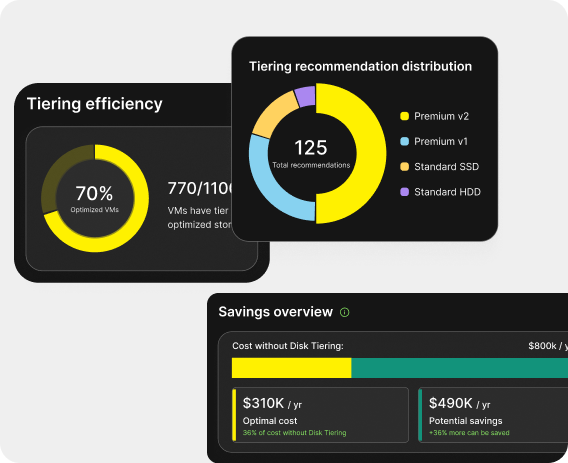
idle disks
Uncover and eliminate idle disk waste beyond the obvious
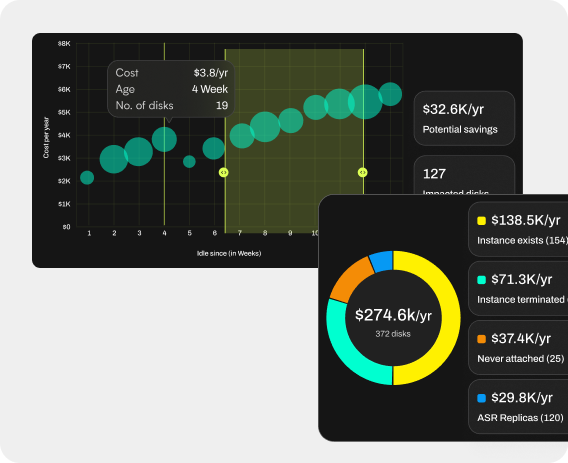
Lumen is the only tool that uniquely identifies and prioritizes four types of idle disks - unattached, reserved, unmounted, and zero-I/O. Together, they can represent up to 70% of your unused block storage spend. See how long each disk has been idle, the full context needed to act safely, and clean up with one click.Enterprise-ready by design
Lumen is built to work within strict enterprise security requirements and operational constraints. Deploy using secure patterns and give teams visibility and control without exposing systems or creating disruption.



“Working with Lucidity has helped us move faster and smarter. Their team gets the challenges we’re trying to solve, and they bring ideas to the table that make a real difference. It’s been a strong, collaborative partnership that’s delivering results and we’re excited about exploring the impact Lumen can make at Dometic.”

Frequently asked questions
Lumen is Lucidity's agentless storage visibility platform. It identifies idle disks, surfaces tier-mismatched volumes, and shows the cost impact of every waste opportunity.
Lumen classifies all four types of idle storage: (1) unattached volumes with no compute attached, (2) orphaned volumes from terminated instances, (3) attached but inactive volumes with no I/O for an extended window, (4) over-tiered volumes.
No. Lumen is fully agentless. It connects via cloud-provider APIs and metadata only.
Lumen identifies tier-mismatched volumes and recommends the right tier, with migration executed as a planned human-in-the-loop change.
Azure Advisor and AWS Compute Optimizer make generic, single-cloud recommendations. Lumen unifies AWS, Azure, and GCP in one view.
Yes — they're designed to work together. Lumen handles visibility and tier optimization, while AutoScaler handles continuous right-sizing of live volumes.
Lumen onboarding takes hours, not weeks. Because it's agentless and read-only, you can be looking at your idle-disk inventory on day one.
Yes. Unattached EBS volumes are one of the four idle disk types Lumen classifies, with one-click cleanup and full cost-impact reporting.
Yes. Lumen identifies AWS EBS gp2 volumes that should migrate to gp3 — typically a 20%+ cost reduction with equal or better performance.
Yes. Lumen evaluates each Azure Managed Disk against its actual IOPS and throughput needs and flags volumes paying for premium performance they don't use.
Disk tiering is the practice of matching each cloud volume to the storage tier that fits its actual workload — for example, Azure Premium SSD for high-IOPS databases, Standard SSD for moderate workloads, Standard HDD for archival. Most enterprises pay for higher tiers than their workloads need; Lumen's autonomous tiering recommendations close that gap.